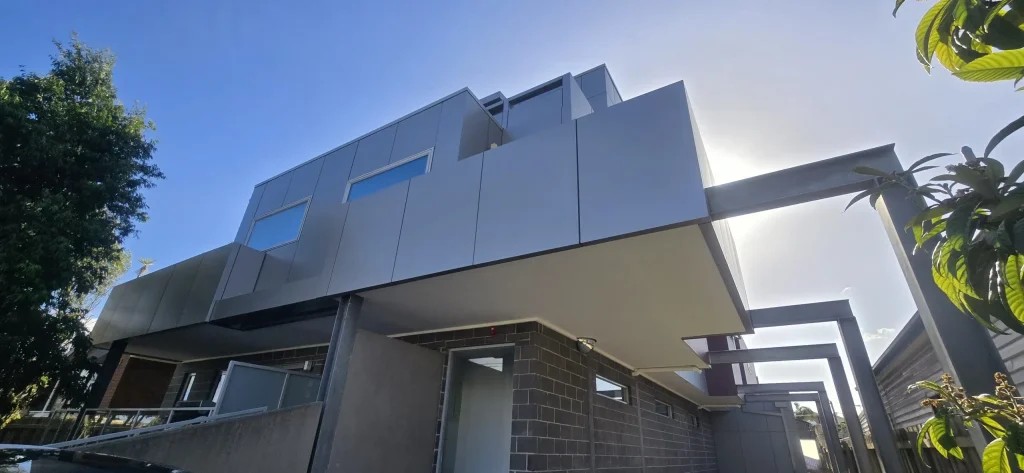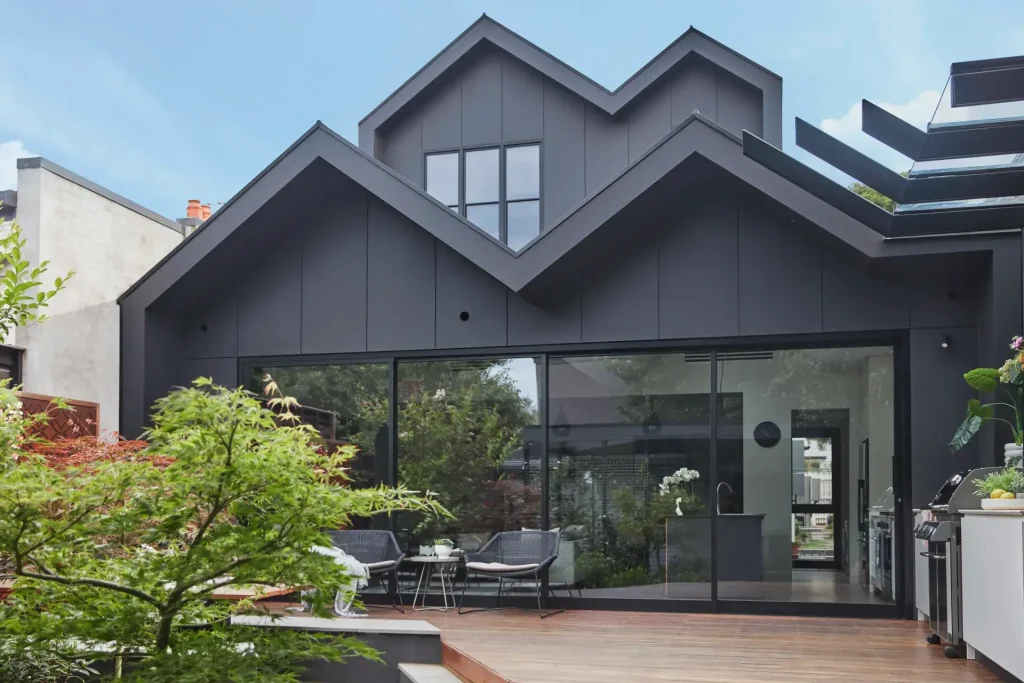
Fibre Cement vs Aluminium Cladding: Which Is Right for Your Project?
Fibre cement and aluminium can both deliver high-performing, contemporary façades, but they solve different design and delivery problems. Fibre cement is often chosen for its mineral character, texture and varied panel finishes, while aluminium is valued for low weight, crisp fabrication, folded details and consistent factory-applied coatings. Neither is automatically the better option. The right choice depends on the exact product, complete wall build-up, building classification, exposure, panel module, maintenance expectations, programme and budget.
For Australian projects, the most useful comparison is therefore not “Which material wins?” but “Which material better fits the façade we are trying to design, document, build and maintain?”
Quick comparison: fibre cement vs aluminium
| Criteria | Fibre cement | Solid aluminium |
|---|---|---|
| Visual character | Mineral, textured, natural or smooth depending on the product | Crisp, precise, metallic or solid-colour finish |
| Weight | Typically heavier per m² than thin solid aluminium panels | Relatively lightweight |
| Fabrication | Can be cut, drilled, routed and in some ranges perforated | Highly suited to folding, cassettes, returns and complex fabricated details |
| Panel format | Large-format boards/panels; dimensions are product-specific | Large sheets/panels; dimensions and fabrication limits are product-specific |
| Finish options | Through-coloured, coated, textured or site-painted, depending on the system | Factory coil-coated or other specified finishes; broad colour range |
| Fire/compliance | Certain fibre-cement products may be permitted where non-combustible materials are required; verify exact product/system | Solid aluminium itself is non-combustible, but the complete external wall must still be assessed |
| Maintenance | Depends on finish, exposure and detailing | Generally low for quality factory finishes, but joints, fixings and coatings still require inspection |
| Best fit | Material-led façades, texture, expressed joints, education/civic/commercial applications | Precision façades, complex folds, recladding, soffits and contemporary commercial applications |
What counts as fibre cement and aluminium cladding?
“Fibre cement” covers a family of cement-based sheet and panel products reinforced with fibres. Products can vary significantly in density, thickness, surface treatment, fixing method and intended application. Architectural products such as EQUITONE can be through-coloured or factory-finished, while other fibre-cement systems may be site-painted or factory-coated.
“Aluminium cladding” also needs clarification. Solid aluminium sheet is different from aluminium composite material and from aluminium corrugated-core panels. For example, CSP’s ALUCOLUX is a 3 mm pre-finished solid aluminium panel. When a project team compares fibre cement with aluminium, the aluminium construction should be named precisely rather than treated as one generic category.
Fire and non-combustibility considerations
Fire performance is one of the areas where broad material labels can create confusion. Australian requirements apply to the external wall construction, not only the visible panel. The ABCB’s guidance on external walls identifies cladding, framing, insulation, sarking and internal lining among components that can form part of an external wall. For Type A and Type B construction, relevant Deemed-to-Satisfy provisions can require external walls and their components to be non-combustible unless a specific concession applies.
That means a non-combustible panel does not, by itself, make the complete façade compliant.
For fibre cement, the exact product should be checked against current technical evidence. EQUITONE, for example, publishes Australian NCC-compliance information for its fibre-cement façade materials. For solid aluminium, products such as ALUCOLUX provide product-specific fire and CodeMark documentation. In both cases, the designer still needs to verify the complete wall build-up, fixing system, cavity, membrane, insulation and any other project-specific requirements.
Appearance and design flexibility
This is where the choice often becomes architectural rather than purely technical.
Fibre cement works particularly well when the façade should feel tactile, mineral or deliberately panelised. Depending on the range, designers can work with natural variation, visible fibres, smooth coatings, textured surfaces and through-coloured material. Expressed joints can become part of the elevation rather than something to hide.
Aluminium creates a different language. Its strength is precision: clean planes, folded corners, cassette forms, returns, soffits, column covers and sharply controlled joint lines. Factory finishes can also provide consistent colour across large elevations.
Neither material is limited to one style. The practical question is whether the design benefits more from fibre cement’s material character or aluminium’s fabrication flexibility.
Weight, panel size and subframe implications
Panel weight influences more than transport. It can affect manual handling, lifting, rail and bracket selection, fixing centres, installation sequencing and the structural design of the support system.
Architectural fibre-cement panels are generally heavier per square metre than thin solid aluminium panels. EQUITONE, for example, publishes product-specific panel weights and sizes for each range. Aluminium can therefore be attractive where lower cladding weight or larger fabricated elements help the design.
However, panel weight is only one input. Wind pressure, panel span, subframe depth, support spacing, cavity requirements and substrate tolerances all influence the final system. A lighter panel does not automatically mean a lighter or cheaper façade once the complete support structure is designed.
Durability and maintenance
Both materials can deliver durable façades when correctly specified, detailed and maintained. The important distinction is how durability is achieved.
Fibre cement is dimensionally stable and does not rely on a metallic substrate, but different products have different surface treatments. A through-coloured panel, a factory-coated panel and a site-painted sheet will not have identical maintenance requirements.
Aluminium does not rust in the same way as ferrous metals, but alloy, coating, cut edges, fixings, interfaces with dissimilar metals and environmental exposure still matter. Coastal and industrial environments deserve particular attention to the manufacturer’s coating and maintenance guidance.
For either material, “low maintenance” should not be interpreted as “no maintenance”. Cleaning, joints, sealants, fixings, drainage paths and coatings should be included in the building’s inspection regime.
Fabrication and installation
Installation strategy can be a deciding factor where the programme is tight or the façade contains complex geometry.
Solid aluminium is highly suited to off-site cutting, routing, folding and cassette fabrication. That can help resolve corners, window returns, soffits and other details before panels reach site. CSP also offers in-house CAD, cutting, rolling and routing services for aluminium panels.
Fibre cement can also be fabricated efficiently. Panels may be cut to module, drilled and, depending on the product, routed or perforated. CSP’s services include cutting cement sheets to required shapes and sizes. The best approach is to coordinate the module, fix the pattern and take off early so avoidable site cutting and wastage are reduced.
What drives the cost difference?
A simple panel-price comparison rarely tells the full story. Installed cost can change with panel dimensions, wastage, subframe design, fabrication, finishing, fixing method, labour, access, programme and quantity.
Fibre cement may appear more economical at the material level on some projects, but site painting, additional handling or a complex fixing pattern can change the installed cost. Aluminium may carry a higher panel or fabrication cost, but off-site processing, lower weight and large-format installation can offset part of that difference in the right project.
For that reason, compare the complete façade package rather than a single $/m² material rate.
Which material fits which project?
| Project scenario | Fibre cement may suit when… | Aluminium may suit when… |
|---|---|---|
| Commercial / mixed-use | Texture, panel rhythm and a material-led expression are priorities. | Crisp geometry, folded details and consistent factory finishes are priorities. |
| Education / civic | Natural or tactile surfaces and durable panelised façades suit the design brief. | Feature zones, soffits or precise metal elements are required. |
| High-rise / multi-storey | A documented fibre-cement façade system suits the engineered wall build-up. | Lower panel weight and fabricated cassette systems suit the façade strategy. |
| Recladding | Existing geometry can accommodate a suitable panel/subframe solution. | Weight, prefabrication and crisp replacement detailing are important. |
| Feature façade | Surface texture or through-colour is central to the concept. | Complex shapes, folds, metallic colour or sharp edges are central to the concept. |
Can fibre cement and aluminium be used together?
Yes. In many projects, the strongest answer is not choosing one material for the entire building.
Fibre cement can form the main field of the façade while aluminium is used at entries, soffits, window surrounds, parapets or feature volumes. Alternatively, aluminium may dominate the primary elevations with fibre cement used to introduce texture and contrast.
The key is to coordinate interfaces carefully. Different materials move differently, require different fixings and may need specific separation or flashing details. The visual transition should therefore be supported by a technically resolved junction.
Selection checklist
- Confirm the building classification, construction type and project-specific compliance requirements.
- Name the exact material and product rather than specifying only “fibre cement” or “aluminium”.
- Review current product evidence, installation manuals and system limitations.
- Compare panel weight, module, fixing method, subframe and cavity requirements.
- Assess environmental exposure, especially coastal or aggressive locations.
- Compare factory finishing, site finishing, cleaning and long-term maintenance.
- Consider fabrication, access, lifting, sequencing and site storage.
- Price the complete installed system rather than only the panel.
- Review physical samples at the intended scale, colour and finish before final selection.
How CSP Architectural can help
CSP Architectural supplies both fibre-cement and façade product families, which makes it possible to compare options without forcing every project toward one material. Relevant ranges include EQUITONE and other fibre-cement products alongside solid aluminium systems such as ALUCOLUX.
CSP can also support the selection process with technical information, samples, estimating and in-house cutting or fabrication services. For an early-stage project, a useful next step is to compare real samples, typical panel modules and the proposed wall build-up before locking in the final material.
Planning a façade? Request fibre-cement and aluminium samples or discuss the project requirements with CSP Architectural.
Frequently Asked Questions
Is aluminium cladding more expensive than fibre cement?
It can be, but not always on an installed-system basis. Panel price is only one factor. Fabrication, subframe, fixing method, finishing, labour, access, wastage and programme can materially change the comparison.
Is fibre cement non-combustible?
Certain fibre-cement products may be permitted where a non-combustible material is required under the NCC. The exact product and complete wall construction still need to be verified against current project requirements and technical evidence.
Which lasts longer: fibre cement or aluminium?
There is no universal winner. Both can provide long service lives when correctly detailed and maintained. Exposure, coating or finish, fixings, joints, workmanship and maintenance often matter as much as the base material.
Which is better near the coast?
Both can be used in coastal projects when the exact system is suitable for the exposure. Aluminium coating, alloy, fixings and interfaces require careful review, while fibre-cement fixings, subframe components and surface finish must also be appropriate for the environment.